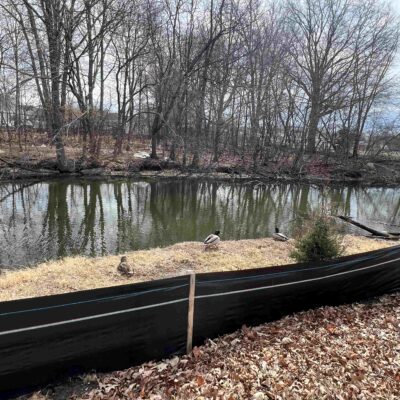
July 30, 2026, was a full day of rain, with over three inches falling in some parts of Cambridge. The day before, Cambridge notified Arlington that the combined sewer overflow (CSO) system would be overwhelmed, causing stormwater to mix with sewage and discharge into Alewife Brook. Expect trails in Alewife Brook Reservation to be flooded, with sewage-contaminated water sometimes flowing into Arlington yards and homes.
Arlington also received notice of discharges on July 22, 23, 8, and on the Fourth of July, forcing some holiday plans to be canceled.
The Massachusetts Water Resources Authority presented the Arlington Select Board with their proposed solution. The conventional engineering response is to capture and store that water until it can be treated. A proposed and much-needed 3-million-gallon storage pipe is now part of the public discussion. With an inch of rain resulting in about 2-million gallons of sewage-contaminated water, more needs to be done.
Living systems invite another question: Can we also slow some of this water, clean it, and return it to the landscape?
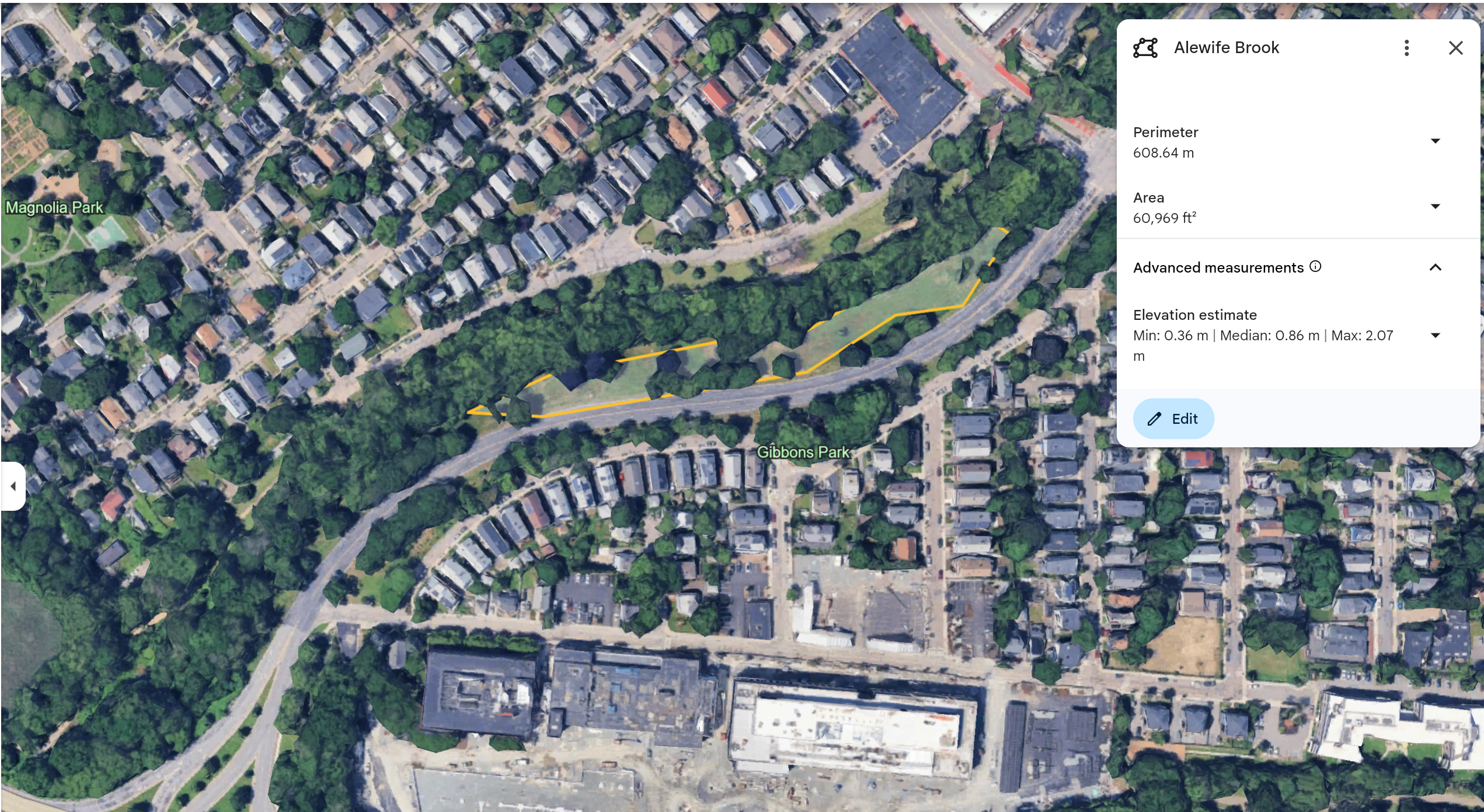
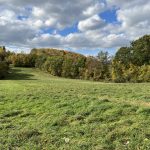
Caption: The open areas between Alewife Brook Parkway and the wooded brook corridor total roughly 60,000 square feet.
Roughly 60,000 square feet of mowed grass lies between Alewife Brook Parkway and the brook from Route 2 to Massachusetts Avenue. The Miyawaki method densely plants young trees and shrubs, often about 18 inches apart. At that density, this corridor could potentially support about 25,000 native trees and shrubs representing a rich diversity of species, many valuable to pollinators.
But this would be more than a forest. It would be an experiment in living infrastructure.
The underlying concept is familiar: a forested leach field. The innovation would be combining subsurface wastewater treatment with a densely planted native forest designed to provide habitat and other ecological benefits.
A pilot system could divert a portion of the combined sewer overflow for treatment rather than allowing it to continue down the brook. After screening to remove sediment and floating debris, the water could be pumped to the upland, where it could pass through engineered biological filters—potentially including wood chips colonized by fungi and beneficial microbes, along with biochar designed to adsorb contaminants.
The water could then be distributed underground through a carefully engineered infiltration system beneath the forest. Much as in a conventional leach field, the soil itself would provide further treatment—but here the treatment zone would also support thousands of native trees and shrubs.
As water moved through the soil, plant roots, fungi, bacteria, and other soil organisms could provide additional biological processing. Trees would return some water to the atmosphere through transpiration. Their roots and accumulated organic matter could improve soil structure and infiltration capacity while creating more biomass above and below ground.
This pilot project is not intended to replace modern wastewater treatment or the conventional infrastructure required to manage combined sewer overflows.
It proposes investigating whether living systems can complement and enhance conventional infrastructure.
If successful, the benefits could extend well beyond water quality. A native forest could provide habitat for birds and pollinators, cool its surroundings, capture carbon, filter air pollution, soften traffic noise from Alewife Brook Parkway, and make the Alewife Greenway more beautiful and welcoming.
Cities across the country are exploring nature-based approaches to managing stormwater in a changing climate. Alewife Brook offers an extraordinary place to test what happens when ecological restoration and conventional engineering are designed together rather than treated as separate worlds.
The Alewife Greenway Path through the DCR’s Alewife Brook Reservation is primarily in Arlington. The land on the other side of the brook is upland and does not flood. The path is more than recreational; it links pedestrians and cyclists in Medford, Somerville, and Arlington to the Alewife Red Line MBTA stop.
How You Can Help
The current public-comment process is an opportunity to broaden the conversation about Alewife Brook beyond sewage and grey infrastructure to include native forests and living infrastructure.
Now Greenway walkers, tree lovers, birders, gardeners, botanists, mushroom foragers, students, educators, ratepayers and others can bring their own perspectives to the discussion.
What could a living forest mean for birds? Pollinators? Fungi and mycorrhizal networks? Salamanders and small mammals? Summer heat? Air pollution? Traffic noise? The experience of walking the Alewife Greenway? Or simply getting more lasting public benefit from the enormous investment required to clean up Alewife Brook?
You don’t need to design the infrastructure. That’s the work of experts. Tell them why the possibility of a living forest matters to you.
Cambridge still needs to solve its sewage problem. But perhaps solving it can be something to crow about.